
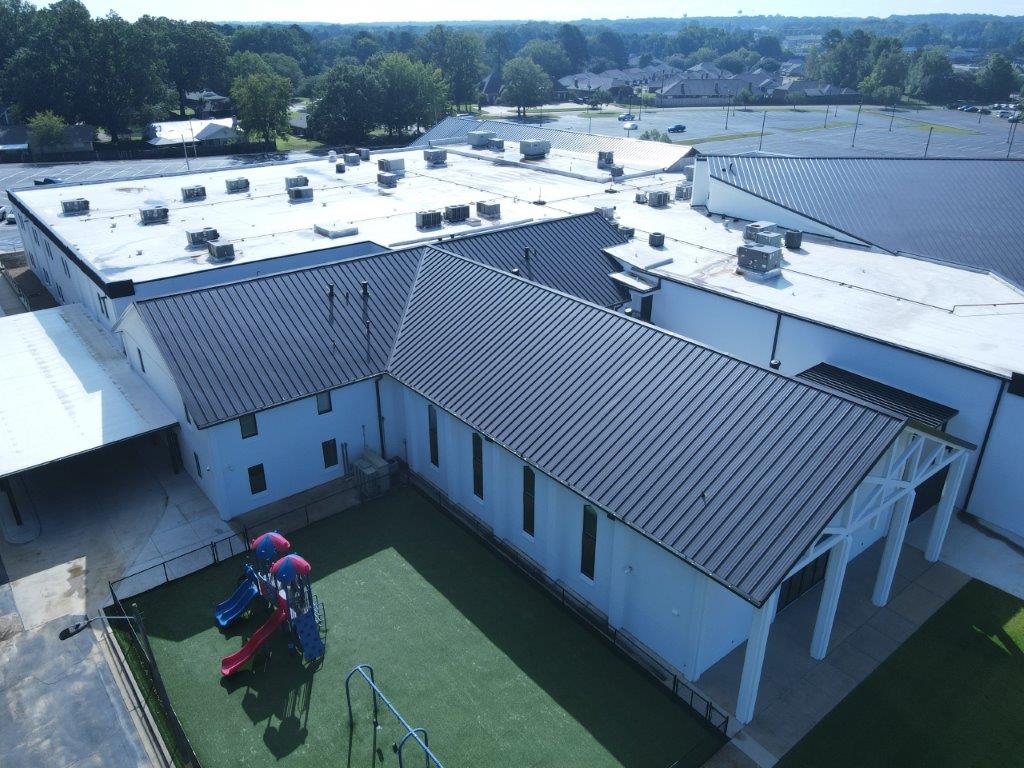
Church and Religious Building Roofing roof planning built from the roof condition.
Commercial roof scope, documentation, access planning, and weather-aware scheduling for acrylic roof coatings.
Washington National Cathedral, the sixth-largest cathedral in the world and the seat of the Episcopal Diocese of Washington, sits on Mount St. Alban and has defined the spiritual and architectural identity of the nation's capital for over a century. While few congregations in DC operate at that scale, every religious organization in the District faces the same combination of challenges that makes commercial roofing here uniquely complex: stringent historic preservation oversight, federal permitting layers that apply to properties near national landmarks, a compressed urban construction environment with strict noise and work-hour ordinances, and a building stock that spans Gilded Age stone churches, mid-century modern sanctuaries, and contemporary community ministry facilities.
Historic preservation is the dominant constraint for DC church reroofing projects. The District's Historic Preservation Office maintains oversight of a large number of designated historic landmarks and historic districts, and many of DC's oldest and most prominent religious buildings fall within these categories. The HPO review process requires documentation of existing conditions, material specifications demonstrating compatibility with historic fabric, and sometimes test patches before full approval. We have navigated these reviews on multiple DC projects and understand what the Historic Preservation Review Board expects: documentation that goes well beyond a standard commercial permit application.
Federal permitting complexity affects DC churches beyond the HPO process. Properties within the viewshed of federally protected landmarks, near Capitol Hill, or adjacent to embassy row may have additional review requirements under National Capital Planning Commission regulations. For churches in the Southwest quadrant or near the National Mall, even routine rooftop equipment replacements may require visual impact assessments. We work with historic preservation consultants and NCPC staff when project scope or location triggers these additional review layers, rather than proceeding on assumptions that later require costly redesign.
The District's urban construction environment imposes noise ordinances, work-hour restrictions, and street use permit requirements that significantly affect project logistics for church facilities in densely developed neighborhoods. Tearoff operations and crane mobilizations require street use permits coordinated with DDOT. Work-hour restrictions limit loud operations to weekday daytime windows that may conflict with church programming. We pre-screen all project logistics against District regulations before establishing project schedules, and we maintain current relationships with the permit offices that govern these operations to resolve conflicts quickly when they arise.
DC churches serve populations with deep roots in specific neighborhoods, and many operate out of historic structures that have been in continuous use for over 150 years. Stone and brick parapet systems, original copper and lead-coated copper flashings, and slate or clay tile pitched roofing sections all require contractor expertise that goes well beyond standard commercial membrane installation. Our DC crews include journeymen with specific training in historic masonry, traditional roofing metal fabrication, and the particular fastening and flashing details required when working on unreinforced masonry parapets in an urban earthquake risk zone.
Many DC congregations, particularly historically Black churches in neighborhoods like Anacostia, Shaw, and Columbia Heights, operate in buildings that have accumulated decades of deferred maintenance and modified systems. These buildings require careful investigation before a reroofing scope is finalized, because the condition of the substrate, existing insulation, and structural roof deck often differs substantially from what records or visual inspection suggest. We budget for investigative demolition and substrate assessment as a standard line item for DC church projects rather than discovering structural surprises after mobilization.
Construction costs in Washington DC are consistently among the highest in the nation, driven by prevailing wage requirements on any project involving federal nexus or tax credit financing, union labor market conditions, and the overhead associated with operating in a highly regulated urban environment. We provide transparent cost breakdowns that distinguish material costs from labor costs and regulatory compliance costs, allowing church finance committees to understand what they are purchasing and to make informed decisions about phasing, material selection, and scope prioritization.
The institutional relationship between DC's religious organizations and the federal government is unique in American civic life, and several large downtown churches maintain direct connections to congressional and executive branch religious affairs functions. These congregations may have security requirements, event-driven construction blackout periods, and coordination obligations with the Secret Service or Capitol Police that affect contractor scheduling. We treat these requirements as logistical planning inputs rather than obstacles, and we have established protocols for working in proximity to federal security perimeters.
Sustainability and environmental stewardship are strong values in the DC church community, and many congregations have adopted formal green building commitments that extend to major capital projects. We offer ENERGY STAR-qualified roofing systems, documentation for LEED existing building credits, and stormwater management features including vegetated roofing sections and detention assemblies that qualify for DC DOEE stormwater fee credits. A church that reduces its stormwater fee through a green roof installation recovers a portion of the roofing investment through ongoing utility savings.
- PVC Roofing
- Commercial Roof Tear Off Replacement
- Insurance Claim Coordination
- Manufacturing Facility Roofing
- University Campus Roofing
- Modified Bitumen Roofing
- Emergency Tarp Dry
- Healthcare Facility Roofing