
Industrial Flex Space Roofing roof planning built from the roof condition.
One roof, many tenants, a hundred penetrations
Industrial flex is the chameleon of the commercial inventory, and the DC region has a deep supply of it, concentrated in the flex and light-industrial parks along Route 1 in Beltsville and College Park, the Steeplechase and Westphalia business parks in Prince George's County, and the warehouse-and-office hybrid product that lines the Capital Beltway approaches in Landover and Lanham. A single building might house light manufacturing in one bay, a distribution tenant in the next, a contractor's shop beside that, and a lab or office build-out at the end, and those uses shift across lease cycles. The roof has to keep performing through all of it, and the multi-tenant, low-slope reality is what makes flex roofing its own discipline rather than just small-scale industrial work.
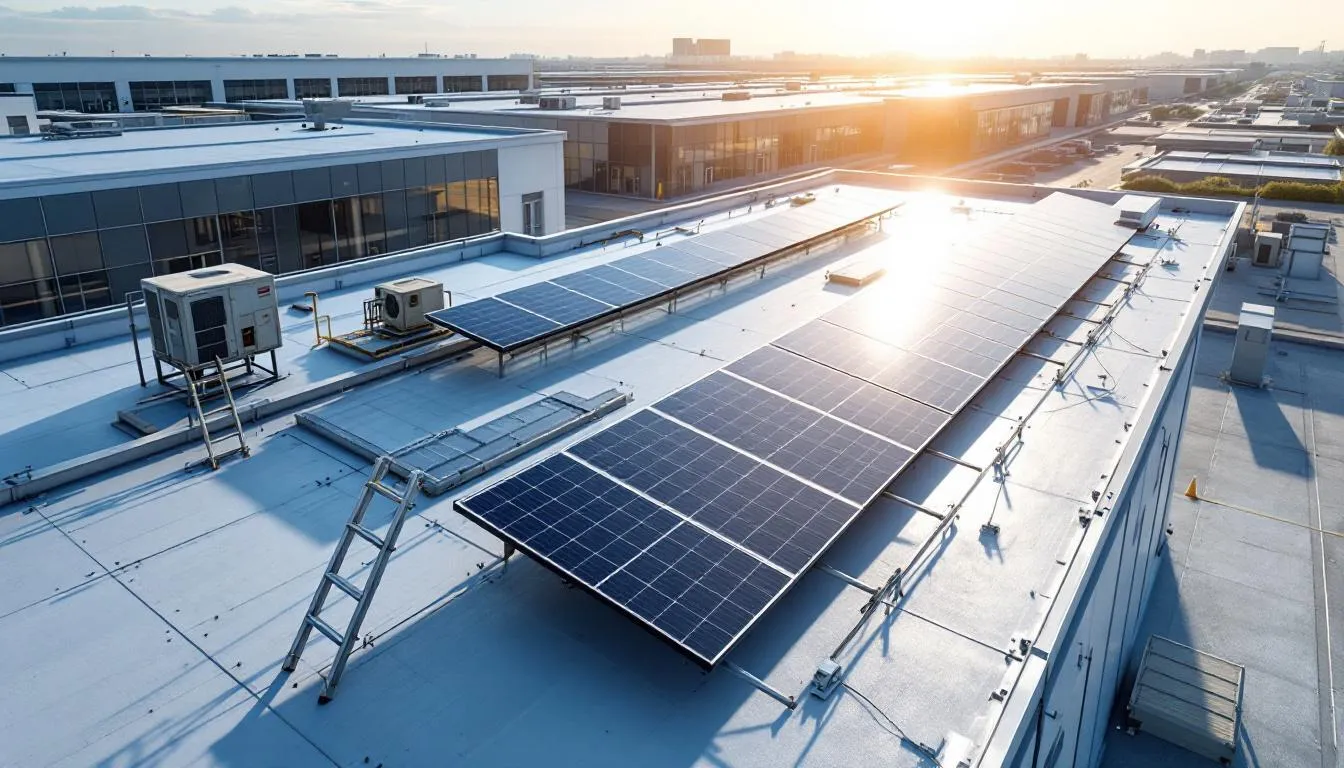
The thing that separates a flex roof from a single-user industrial roof is the sheer accumulation of penetrations and modifications over time. Every tenant improvement that adds a rooftop unit, runs new electrical or HVAC, or sets equipment that was never in the original loading plan leaves another hole and another curb in the membrane. None of it is necessarily done badly; it is just that, lease by lease, the roof collects years of changes that rarely make it into the property records. That is why we begin every flex scope with a penetration inventory rather than trusting the drawings.
The pre-project survey is the whole game
On a flex building, what you do not know about the roof is the risk. We photograph and map every penetration, compare it against the original construction documents where they exist, and flag the non-standard or improperly sealed ones that need remediation before any new membrane goes down. Abandoned curb openings from a tenant who pulled their unit, undocumented gas and electrical penetrations, drains that have been quietly clogging since the last occupancy change, these are the items that turn into warranty disputes after completion if they are not caught first. The survey is not a formality on these buildings; it is how we keep a clean reroof from inheriting someone else's improvisation.
Lease transitions concentrate that risk. When a tenant vacates and the HVAC comes off, the curb openings often get a piece of temporary protection that fails inside one or two rain events, and vacant bays collect debris in the drains faster than occupied ones because nobody is up there. A flex inspection during a lease turnover should always confirm curb-cap status, verify former-tenant penetrations are properly sealed, and check that the drainage is clear. We make that part of the standard walk for any property manager handling a transition.
Matching the system to the building's vintage
Flex stock in the DC corridors spans decades. Older tilt-wall and concrete buildings from the 1970s and 80s often still carry built-up roofing, while newer pre-engineered metal buildings run standing seam or R-panel. The reroof spec follows the deck type, the existing assembly condition, and how much occupancy disruption the current tenant mix can tolerate. For tilt-wall and concrete flex, a 60-mil TPO mechanically attached over tapered polyiso is the cost-effective workhorse, stepped up to 80-mil TPO or 60-mil PVC fully adhered where rooftop equipment density and multi-tenant service traffic justify the added puncture and traffic resistance. For pre-engineered metal buildings, a standing-seam recover or a silicone-coated metal approach can extend service life without a full teardown, and we evaluate that against full replacement based on panel condition, purlin spacing, and load capacity.
Variable interior loads and the moisture that follows them
The reason flex roofs are hard to spec generically is that the building below changes from bay to bay. A light-manufacturing tenant might run process equipment and exhaust that loads the air with heat and humidity, the distribution bay next door is essentially a dry warehouse, and a lab or commissary build-out introduces washdown and steam the original roof never anticipated. Those different interior climates put different demands on the same continuous membrane, and a humid bay can drive moisture into an assembly that is performing fine over the dry bay beside it. We look at what each tenant is actually doing under the roof, not just the square footage, because the interior loads determine where condensation and premature aging will show up first.
Insulation and drainage carry the consequences of all that variability. Tapered insulation that directs water cleanly to the drains matters more on a flex roof than on a single-use building, because the penetration count is higher and every low spot near a curb is another opportunity for water to find a marginal detail. Where a humid tenant occupies a bay, we pay particular attention to vapor behavior in the assembly above them so the roof is not quietly wetting from below while it sheds rain perfectly from above. Matching the assembly to the real mix of uses is what keeps a flex roof from failing in patches that track the tenant map.
Coordinating work across tenants who do not share a schedule
Multi-tenant coordination is the operational heart of a flex reroof. We start from a bay-by-bay occupancy map and lease-contact list from property management, identify which tenants have live rooftop equipment, which bays sit vacant, and which occupants are sensitive to noise or HVAC downtime. Work sequencing and daily dry-in are coordinated through the property manager, with tenants given advance notice but communicating through management rather than directly with the crew, so the project stays orderly across very different lease terms and operating hours. For investors and managers running a portfolio of flex assets, we standardize the condition reporting so it feeds straight into capital planning across multiple properties.
Common questions from DC flex owners and managers
- How do you deal with all the tenant-added penetrations? The pre-project survey photographs and maps every penetration, compares it to the original drawings where available, and identifies non-standard or unsealed ones for remediation before new membrane goes on. That heads off warranty disputes later.
- What membrane is best for a multi-tenant flex building? A 60-mil TPO mechanically attached over tapered polyiso for most tilt-wall and concrete buildings, stepped up to 80-mil TPO or 60-mil PVC fully adhered where equipment density and service traffic are high.
- How do you coordinate tenants on different leases and schedules? From a bay-by-bay occupancy map and lease-contact list. We identify live equipment, vacant bays, and noise-sensitive tenants, then sequence the work and daily dry-in through property management, not directly with each tenant.
- How do you price flex roofing for portfolios? Per roof square, based on membrane spec, assembly condition, penetration density, and bay configuration, quoted fixed-price after a roof walk and core where needed. Portfolio owners get standardized condition reports for capital planning.
- Do you handle pre-engineered metal roofs? Yes. We evaluate standing-seam recover and silicone-coated metal systems against full tear-off based on panel condition, purlin spacing, and load capacity, and install both.