
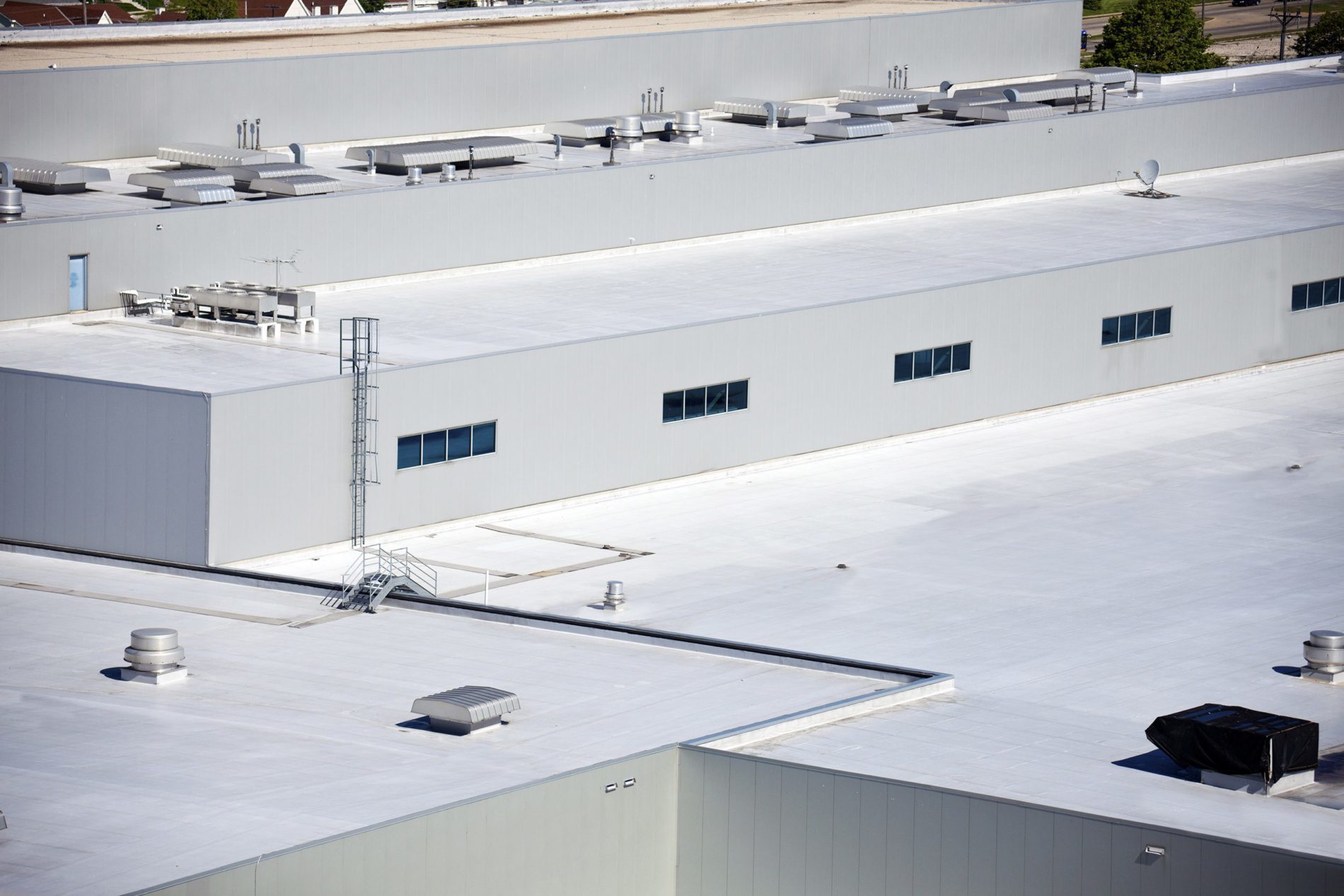
Manufacturing Facility Roofing roof planning built from the roof condition.
Commercial roof scope, documentation, access planning, and weather-aware scheduling for acrylic roof coatings.
Leidos, one of the Washington area's largest defense and intelligence contractors, operates research, engineering, and systems integration facilities across the DC metro corridor that represent the specific roofing challenges of the defense contracting industrial base. Unlike the publicly visible federal buildings on the National Mall, defense contractor facilities in the DC area, concentrated in Northern Virginia and suburban Maryland but extending into the District itself, are classified industrial and research structures where roofing work must comply with security protocols, physical access restrictions, and in some cases government-mandated foreign national exclusion requirements that dramatically complicate the labor pool available to a roofing contractor.
The chemical and electronic environment in defense contractor research facilities creates roofing challenges that are unusual even by industrial standards. Facilities that house radar cross-section measurement, electronic warfare testing, and signals intelligence equipment often carry significant electromagnetic shielding requirements that extend to roof penetrations. Any new penetration through the roof deck must be evaluated for its effect on the building's RF shielding envelope, and penetrations that are required for HVAC or plumbing must use shielded sleeve assemblies that a standard commercial roofer is unlikely to have encountered. Contractors bidding on DC defense contractor roofing must ask about shielding requirements during the pre-bid walkthrough rather than discovering them after contract execution.
Vibration in defense manufacturing facilities in the DC area tends to come from large environmental test chambers, acoustics laboratories, and electronics assembly operations rather than the metalworking machinery found in traditional manufacturing. The roofing implication is similar, cyclic stress at deck connections and membrane seams, but the amplitude and frequency profiles differ. Some test chambers in DC-area defense facilities generate low-frequency vibration signatures that are specifically tuned to avoid building resonance, and a roofing inspector who understands this context will look for fatigue cracking in the structural deck connections above these chambers as a priority area during condition assessment.
Security-cleared labor requirements present a genuine logistical challenge for roofing projects on cleared defense contractor facilities in the DC area. Individual access to certain areas may require a minimum Secret clearance, and the roofing contractor must either maintain a cadre of cleared workers or arrange for cleared facility escorts, who have their own primary duties, to accompany workers throughout the workday. The additional supervision cost is real and must be accounted for in proposals. Contractors who work regularly in the Northern Virginia and suburban Maryland defense corridor have established relationships with cleared labor pools and understand how to structure the security coordination paperwork required by DCSA.
Washington DC's urban environment adds logistical complexity to every manufacturing facility roofing project regardless of classification. Material delivery windows are often restricted by local traffic management requirements, crane permits require coordination with DDOT and in some cases FAA notification for operations near Reagan National flight paths, and debris management must account for the district's strict environmental controls on roofing tear-off material. Contractors experienced in DC work maintain pre-existing relationships with licensed debris haulers who understand the documentation requirements for regulated materials including asbestos-containing legacy flashings, which remain present in many older DC-area industrial buildings.
Skylights in DC-area defense contractor facilities are less common than in production-oriented manufacturing, because much of the work involves electronic and software systems that benefit from controlled lighting. Where skylights do exist, they are often translucent panels in older facilities that have become brittle and are approaching end-of-service life simultaneously with the surrounding membrane. Replacing these panels with current-generation polycarbonate or glass-fiber reinforced units during a re-roofing project is almost always more cost-effective than scheduling a separate specialty contractor return visit, and the improved impact resistance of current-generation panels is particularly relevant given the DC area's occasional hail events in spring and summer.
Process chemical exposure in DC defense contractor facilities is less severe than in petrochemical or pharmaceutical manufacturing, but electronics manufacturing and test facilities use solvents and flux compounds that can volatilize and affect roofing materials. Flux residue from large-scale circuit board assembly operations has been documented as a cause of premature adhesion failure in roofing systems installed on buildings directly above those operations. Vapor barriers installed above the insulation layer, sometimes called vapor retarders in cold climate applications, serve double duty in these buildings by limiting solvent vapor transmission from interior to the membrane interface.
DC's humid subtropical climate, combined with the urban heat island effect in denser parts of the metro area, creates elevated membrane surface temperatures that accelerate thermal cycling fatigue. White or light-colored membrane surfaces, already required by DC's green building regulations in many circumstances, address this by significantly reducing membrane surface temperatures relative to dark surfaces. The DC Green Building Code and DC's stormwater retention requirements also mandate specific provisions for rooftop vegetation or engineered retention systems on new and substantially renovated roofs above a certain area threshold, which affects the structural loading analysis that must precede any re-roofing project.
Preventive maintenance on DC defense contractor facility roofs requires formal work order systems coordinated through the government contracting officer's representative or facility security officer, depending on the classification level of the space below. Annual inspection programs must be structured to allow for the access notification lead time, often 72 hours or more, required by facility security. Contractors who maintain standing maintenance agreements with DC-area defense facilities build this notification lead time into their scheduling systems and provide security-compliant inspector identification packages rather than simply showing up at the gate on inspection day.
- Modified Bitumen Roofing
- Commercial Roof Leak Repair
- Edge Metal Coping Gutters
- Self Storage Roofing
- Mixed Use Roofing
- Spray Foam Roofing
- Skylight Penetration Flashing
- Hotel Roofing