
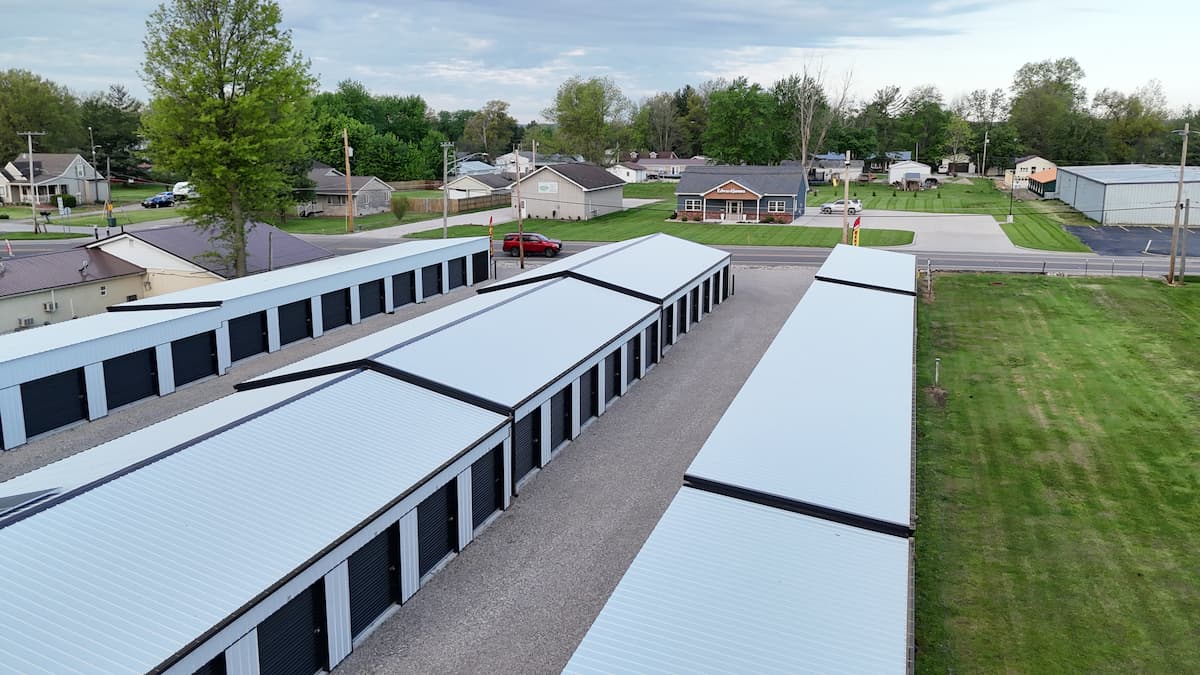
Self-Storage Facility Roofing roof planning built from the roof condition.
Commercial roof scope, documentation, access planning, and weather-aware scheduling for acrylic roof coatings.
CubeSmart Self Storage operates multiple Washington DC locations including facilities in the dense urban corridors of upper Northwest and along New York Avenue NE, serving a customer base defined by the city's transient professional population, downtown apartment dwellers, and small businesses that cannot afford the square footage to store inventory on-site. Urban self-storage in DC presents roofing challenges that differ fundamentally from suburban campus facilities: buildings are taller, footprints are smaller relative to total storage volume, roof access is often shared with HVAC mechanical equipment serving multiple floors, and zoning and historic district regulations can constrain what work can be done and how materials can be moved.
Urban density in the District creates significant logistical constraints for commercial roofing projects. Equipment staging, material delivery, and waste removal all require coordination with building management, adjacent property owners, and in many cases DC Department of Transportation for lane use permits. Our urban project teams are experienced in the permitting requirements specific to Washington DC, including the requirements of the DC Office of Buildings and the specific insurance and safety protocols required for projects adjacent to high-pedestrian-traffic corridors like H Street, Columbia Road, and the U Street neighborhood.
Many of DC's older urban self-storage buildings, including converted warehouses and early twentieth-century commercial structures, have roofs that have been modified repeatedly over their lives without comprehensive drainage re-engineering. Layers of modified bitumen over original built-up roofing, ad hoc drain modifications to accommodate HVAC additions, and parapet wall flashing that has been patched across multiple decades all create complex starting conditions for a reroofing project. Our pre-project investigations include core sampling, drain mapping, and structural assessment to understand what we are working with before any proposal is written.
Energy codes in Washington DC have become progressively more stringent, and reroofing projects trigger requirements for minimum insulation R-values that older buildings may not currently meet. DC Energy Conservation Code requirements for commercial roofs in Climate Zone 4A call for continuous insulation values that often require adding insulation thickness as part of the reroofing scope. We design insulation packages to meet current code while staying within structural weight limits, using high-density polyisocyanurate boards to maximize R-value per inch of added thickness.
DC's weather includes meaningful winter snowfall and ice events that matter for self-storage roof performance, despite the city's mid-Atlantic location. Ponding water that freezes on flat roofs accelerates membrane aging and can create ice dam conditions at parapet drains. Positive drainage slopes are especially important in DC because the mid-Atlantic climate delivers both summer humidity events and winter icing, demanding a roof system that performs across a wider temperature range than either a purely cold-climate or purely warm-climate system.
Several urban self-storage properties in Washington DC occupy buildings that are in or adjacent to historic districts governed by the DC Historic Preservation Office. While self-storage buildings are rarely individually landmarked, properties in historic districts may have restrictions on rooftop equipment visibility or exterior alteration that affect how mechanical penetrations and rooftop structures can be configured. We work with owners and their preservation consultants when historic district considerations arise, designing solutions that meet both roofing performance requirements and regulatory constraints.
Commercial roofing assessments for DC self-storage operators are available throughout the District, from Capitol Hill through Anacostia and from Tenleytown to the waterfront. We have the permitting relationships, equipment capabilities, and urban project management experience that high-density DC locations require, and we provide written condition reports that support property management and capital planning decisions for buildings in one of the country's most demanding urban markets.