
Solar Roof Integration roof planning built from the roof condition.
The Roofing Side of a Solar Project in Washington, DC
By the time most owners call us, a solar developer has already walked their building, sketched a panel layout, and quoted a production number. What nobody has looked at yet is the thing the entire array is going to sit on. That is our half of the job. We don't sell panels and we aren't paid on system size, so when a District building owner is weighing rooftop photovoltaics, we are the party in the room whose only concern is whether the roof can carry that array for the next two decades without leaking, sagging, or voiding its own warranty.
Demand here is driven by policy as much as by sunlight. The District's Solar for All initiative and an aggressive local Renewable Portfolio Standard have made DC's Solar Renewable Energy Credits some of the most valuable in the country, which is why flat commercial and warehouse rooftops east of the river and along the industrial belt north of Florida Avenue have suddenly become assets worth covering in glass. The incentive is genuine. The hazard is that it tempts owners to bolt a long-lived array onto a membrane that is already near the end of its run.
Start by Grading the Roof You Already Have
We open every solar conversation with cores and a moisture scan, not a racking layout. Cut a few test plugs and you learn three things the panel quote never mentions: how many ply or how much membrane life is actually left, whether the insulation underneath is dry, and what shape the deck is in. From that we write a remaining-service-life figure ownership can act on. If the roof has well over a decade of honest life, panels can go on now. If it is down to its last handful of years, we say so plainly, because nobody wants to pay a crew to lift an entire array off, set it aside, reroof, and reset it a few years into a thirty-year solar lease. That detach-and-reset bill is the avoidable disaster at the center of badly sequenced solar work.
Ballast, Attachment, and What the Deck Can Take
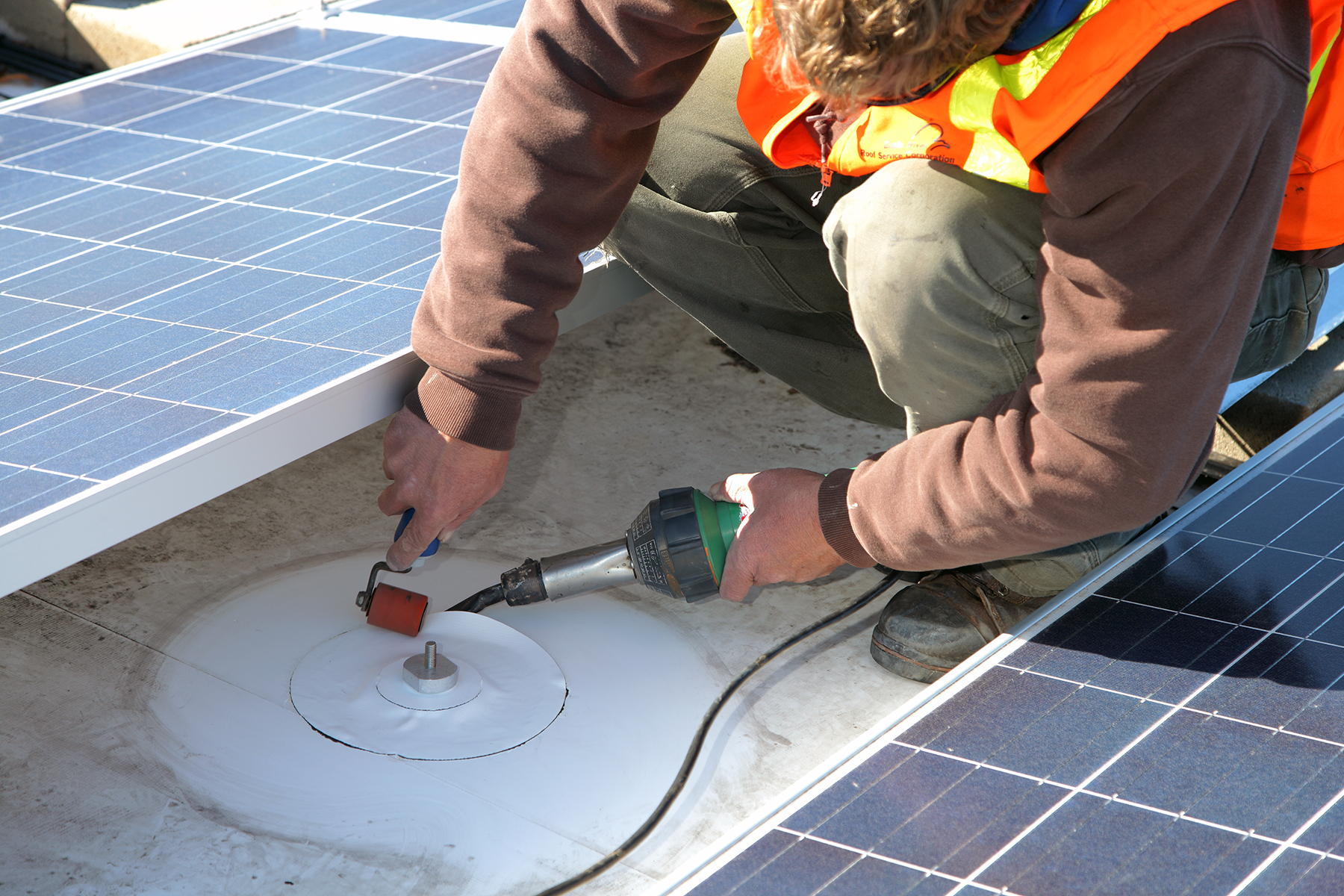
How the array stays put is a structural question dressed up as a solar one. Ballasted racking rests on weighted trays and never punches the membrane, which is the tidy answer on a healthy single-ply roof. But ballast is dead weight, and plenty of the steel-deck and concrete buildings around DC predate any expectation of carrying several pounds per square foot of added load across the whole roof. We pull the structural capacity before anyone trusts a ballasted design. Where the deck is tight, we switch to mechanically attached racking, which trades weight for penetrations. Every one of those attachment feet is a hole in the roof, and a hole in the roof is a leak unless it is flashed to the membrane maker's published detail. We flash those feet ourselves rather than let a solar crew shoot a generic boot over a structural fastener and call it sealed.
Picking a Membrane That Likes Living Under Panels
Under most arrays we want a reflective white TPO or PVC sheet. Panels lose output as they heat up, and a cool white roof keeps module temperatures down so the system produces closer to its rating instead of cooking on a black surface all afternoon. PVC has a second advantage: it shrugs off the oils and chemical exposure that collect around rooftop equipment. Whatever sheet we land on, the walk pads and racking bearing points have to be chemically compatible with it, and the membrane goes down and gets inspected before a single module is staged. Building the roof under a finished array is how leaks become permanent.
The Penetrations Nobody Budgets For
On a solar roof the panels rarely leak. The wiring does. Conduit carrying the array's output down to the building's electrical room crosses the membrane at several points, and if that conduit is strapped flat to the sheet it saws into the roof every time the metal grows and shrinks in the sun. We sit down with the PV contractor during preconstruction and map those penetrations, set proper curbs or pitch pans, and lay protective walkways along the service routes so the technicians maintaining the system for twenty years aren't grinding the membrane down under their boots. These are roofing details, and we keep them on our side of the line.
Keeping Two Warranties Alive at Once
This is where solar-plus-roof jobs quietly fall apart on paper. The membrane manufacturer holds one warranty and the equipment manufacturer holds another, and a careless interface can void either. Most major single-ply makers will leave a no-dollar-limit warranty in force beneath an array only when the system was submitted and approved before installation: approved ballast trays, approved penetration details, approved walkway protection, and a field-rep sign-off. We drive that submittal before the racking ships, photograph the as-built penetrations, and confirm both the roofing and the PV warranties register cleanly. Our incentive sits entirely with the roof, which is exactly why we are the right party to protect it.
What We Handle on a Solar Roof
- Core sampling, moisture scan, and a written remaining-service-life grade before any solar commitment
- Structural load check on ballasted designs against the building's actual deck capacity
- Reflective TPO or PVC specification chosen to keep modules cool and producing
- Manufacturer-detail flashing on every attachment foot and conduit crossing
- Preconstruction coordination with the PV contractor on routing, sequence, and details
- Manufacturer submittal and as-built records that keep both warranties in force
Common Questions About Solar Roof Integration in Washington, DC
Should we replace the roof before adding panels?
It comes down to what the membrane has left, which is why we core it first. A roof with well over a decade of documented life can take an array as it stands. A roof near the end almost always should be replaced before the panels go up, because removing and reinstalling a system during a later reroof costs far more than reroofing now onto a clean surface. We give you the grade in writing so the call rests on evidence.
Do the panels have to put holes in the roof?
Not always. Ballasted racking weighs the array down without ever piercing the membrane, which suits a sound flat roof. The catch is that ballast adds dead load the deck has to carry, and on older DC buildings near their limit we use mechanical attachment instead. When we do penetrate, every foot is flashed to the manufacturer's detail and stays under the membrane warranty.
Will solar void our existing roof warranty?
Only if the connection is botched. Major single-ply makers keep the warranty alive over an array when the system uses approved trays and penetration details and clears their field rep before it goes up. We run that submittal in advance and document the finished work so both the roofing and solar warranties stay valid.
What membrane do you put under an array?
Usually a reflective white TPO or PVC. The cool surface holds module temperatures down so the panels make more power, and PVC in particular handles the chemical exposure common around rooftop gear. The racking and walk pads have to be compatible with whichever sheet we install.
Who is responsible for flashing the conduit, you or the electrician?
We are. Anything that crosses the membrane is a roofing detail, not an electrical one. We plan the routing with the solar contractor and set the curbs and pitch pans before the wire is pulled, because conduit strapped straight to the sheet is one of the most reliable ways to start a leak on a solar roof.